One of the things I love most about studying great pianists is that a single moment can open up a whole world of harmonic possibilities. This blog post is about one of those moments. It comes from one of the first jazz albums I ever owned: Bill Evans’ Portrait in Jazz (1960). We’re going to look at how Bill Evans plays a ii-V at the end of the first half of “Someday My Prince Will Come”, and then see how far we can take it.
Listen below (the moment we’ll discuss is at 0:15):
The ii-V
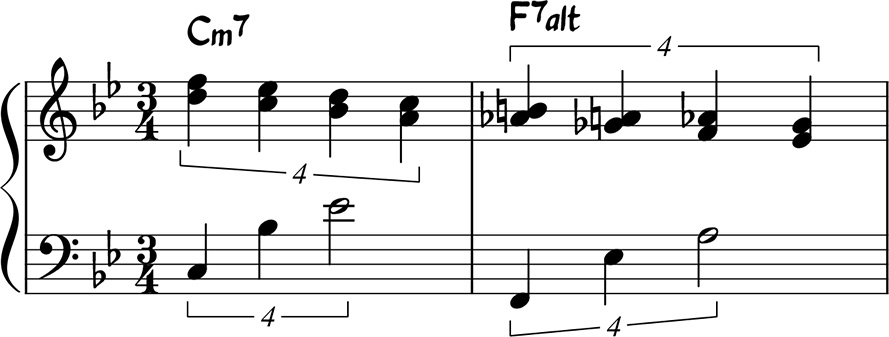
Let’s start with what Evans actually plays. This is a ii-V in B♭ major, so Cm7 – F7:
The left hand plays root, 7th, and 3rd on both Cm7 and F7. On Cm7, the melody starts on F and goes down the scale, harmonized with a third underneath. On F7, the melody continues down the scale, following the F7 altered scale (with a ♯11, ♯9, ♭9).
Step 1: Use B7 instead of F7
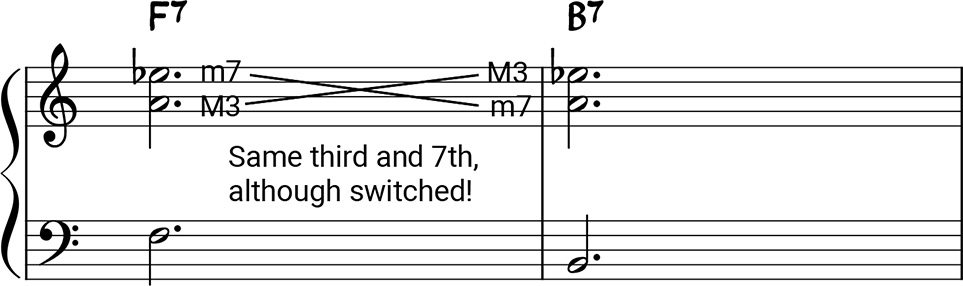
F7 and B7 are closely related; they share the same third and seventh:
F7: third = A, seventh = E♭
B7: third = D♯ (= E♭), seventh = A
This is called a tritone substitute chord. On a dominant chord, we can replace the bass with its tritone (in this case B) changing the chord but not fundamentally changing its function.
Step 2: Turn B7 into a ii-V
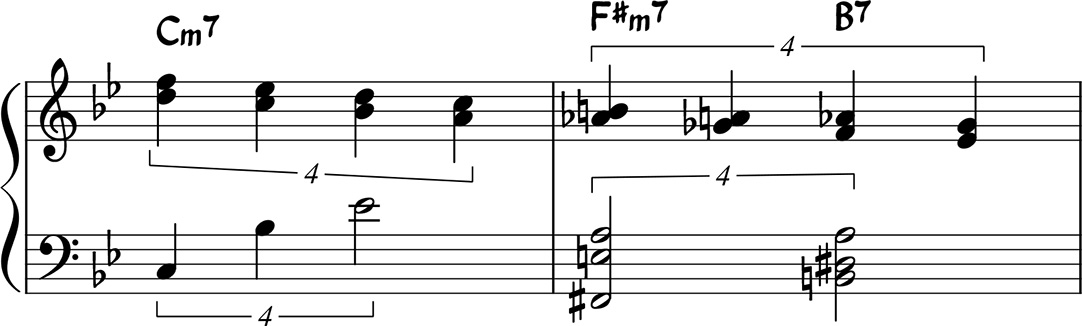
If B7 is the V, then E is the root, and F♯m7 is the ii-chord. This gives us a complete tritone-substitute ii-V:
F♯m7 – B7
This fits Bill Evans’ melody nicely:
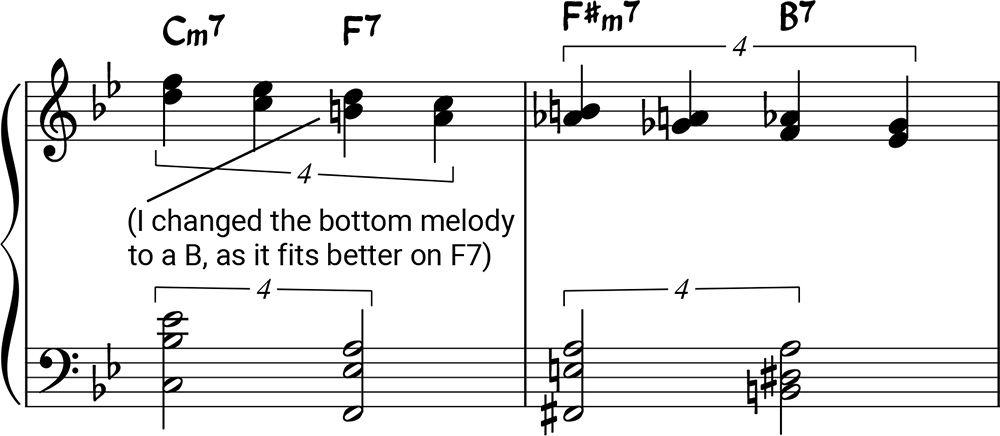
Now let’s give Cm7 its dominant chord back (F7), but put it in the same measure:
Step 3: Split the tritone
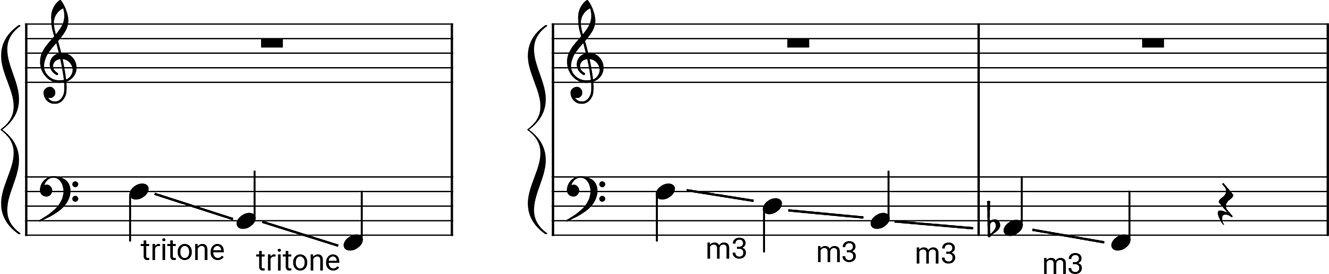
So far, we have a ii-V followed by its tritone-substitute ii-V. A tritone splits the octave in half. What if we split the tritone in half as well?
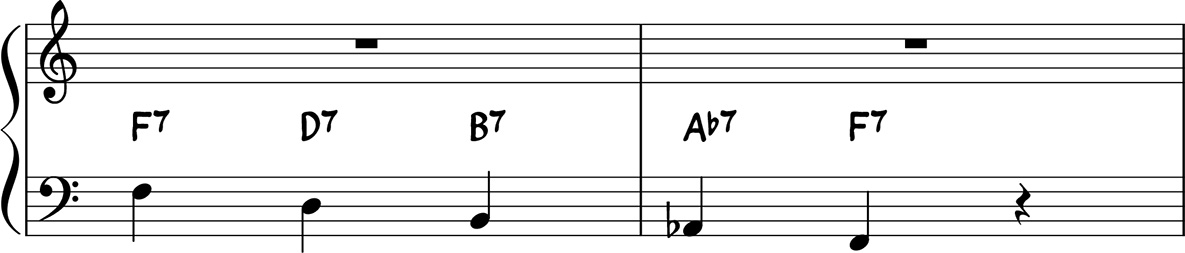
If we divide a tritone, we get a minor third. Now we’ve ended up with 4 minor thirds moving down.
Let’s write down the dominant 7th chords on these notes:
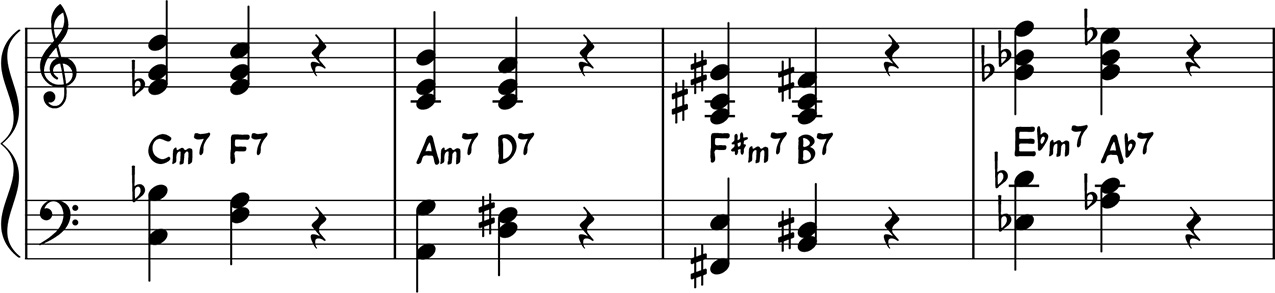
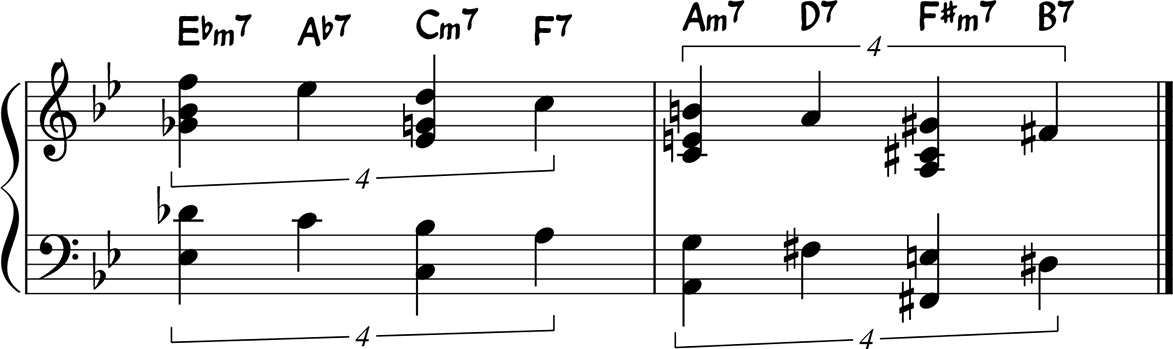
Next, let’s add in the ii-chords that belong to these V-chords and write down the voicings:
Note how this is like an eternal progression: you could keep moving down in minor thirds with these four chords forever.
Step 4: Harmonize Evans' melody
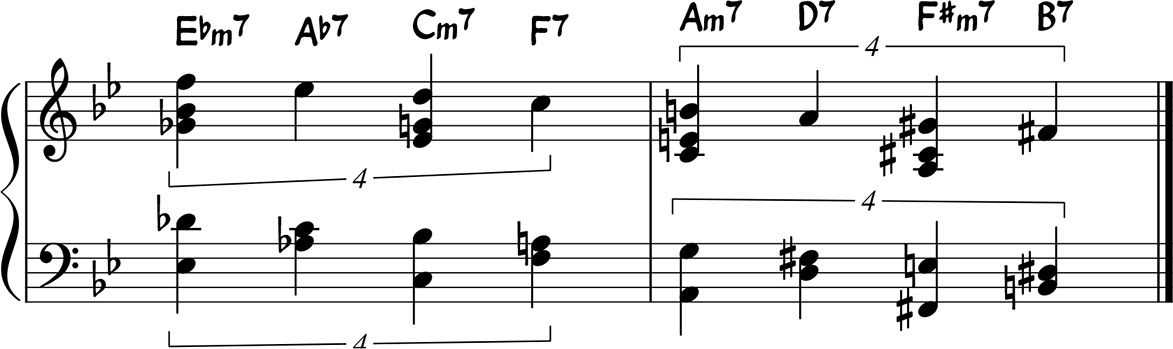
Let’s go back to Bill Evans’ melody and harmonize it using these chords. I think we should end with the B7 chord — it has a lot of tension but resolves back to B♭ (the tonic) organically. That means we start on E♭m7 – A♭7.
The melody happens to be perfect for this progression. It’s completely symmetrical, going down in alternating whole steps and half steps — which mirrors exactly what the harmony is doing.
One trick is to omit the V7-chords bass notes in the left hand. Playing the thirds (i.e. C on Ab7) is enough to give you a “sense” of ii-V. This allows for a little breathing room, and it’s also slightly easier to play if you’re playing fast runs like these:
Full reharmonization
If you want to hear these ideas in action, here’s my own reharmonization of “Someday My Prince Will Come”, which uses this progression alongside several other techniques, you can listen to it below. And as always, if you’d like to explore more reharmonization techniques, make sure to grab my free Reharmonization Quick Guidehere.
Bonus question
As always, I recommend practicing this progression in all keys. But how many truly unique versions exist? In other words, how many different versions of this progression can we really practice?
Let me know in the comments if you figured it out!
Thanks, Jorn. Great reharm, but maybe I can hear too much dissonant harmonies, but sounds interestion.
Bill is absolutely amazing, as always. I have a book about his harmonic style.
Thanks Alexander! I actually toned this one down a bit from my original arrangement, which was much more dissonant. I thought this one was not that spicy, haha. Just proves music is very subjective. Bill Evans is amazing indeed, one of my main influences.
Turn a name into a one-of-a-kind piano piece. Audio starts at $175, with optional video and sheet music. Once you submit your request, I’ll review it and send you an invoice. After payment, I’ll compose your piece and deliver it within 7–14 days.
Where should I send your free Reharmonization Quick Guide?



6 Responses
Bravo!
Gorgeous arrangement, beautiful playing.
Thank you!
Thanks so much, glad you enjoyed it!
Thanks, Jorn. Great reharm, but maybe I can hear too much dissonant harmonies, but sounds interestion.
Bill is absolutely amazing, as always. I have a book about his harmonic style.
Thanks Alexander! I actually toned this one down a bit from my original arrangement, which was much more dissonant. I thought this one was not that spicy, haha. Just proves music is very subjective. Bill Evans is amazing indeed, one of my main influences.
All the best!
Brilliant interpretation as always from one of NY’s smartest pianists! Thanks for nerding out for the benefit of the rest of us.
Hey, thanks so much, Mark! I appreciate you joining me in my nerding out